

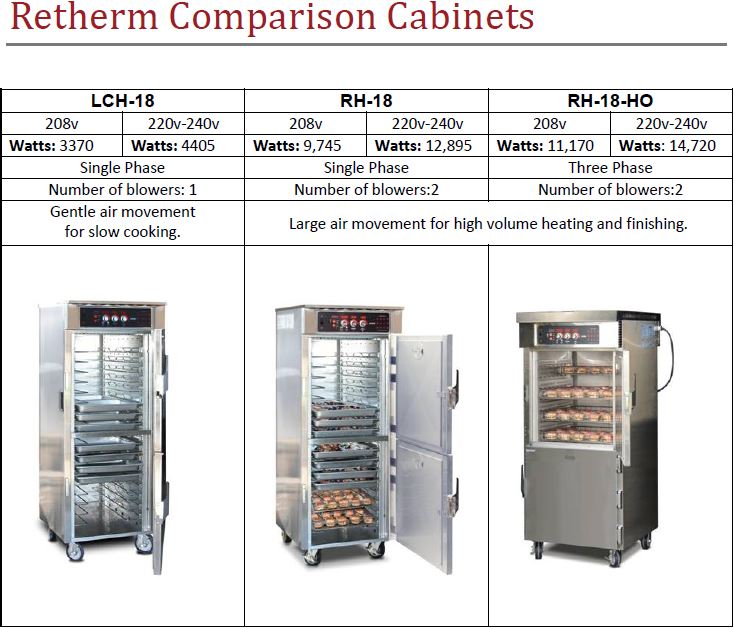
 less are preferred to allow for a safe amount of flexible preparation and cooking time. Retherm ovens are typically found in large institutions such as school, hospitals, and prisons. Retherm ovens allow food preparation to occur off-site, catering to centralized kitchens with satellite operation that have a minimum of other expensive cooking equipment, as well as associated kitchen ventilation systems. Because retherm ovens such as the FWE RH-18, top out at a maximum temperature of 350°F, in most states these ovens are not required to be under expensive ventilation hoods.
In many respects, retherm ovens are similar in design to low temperature convection ovens. A retherm oven however, has about four times the wattage and double the air movement to increase energy transfer efficiency. Retherm efficiency is the transfer of energy from a heated cabinet to a thermal mass (food) in a fast and controlled rate. Testing determines how effective Retherming energy transfers to a thermal mass (food). By testing an empty cabinet and a loaded cabinet, we can compare the energy transfer in kW to the thermal mass (food). Retherm-energy efficiency is a measure of how much of the energy that an appliance consumes is actually delivered to the food product during the rethermalization process.

The larger the thermal mass, the more energy (kW), is needed to transfer to the mass. In the same regards, the more energy (kW) the faster the thermal mass can absorb the energy and reach desired temperatures.
 Foodservice.me