
Energy Efficiency ($$$’s not ZZZ’s)

Continue reading “Foodservice Equipment – Energy Efficiency”
Continue reading “Foodservice Equipment – Energy Efficiency”
Food safety is paramount in any foodservice facility. Here are a few key numbers that can help you keep your customers safe from the evils of hazardous food. please be aware however, every local municipality and their local codes prevail, this is only a guide.
Always use an accurate food thermometer to make sure foods are cooked to and held at a safe temperature.
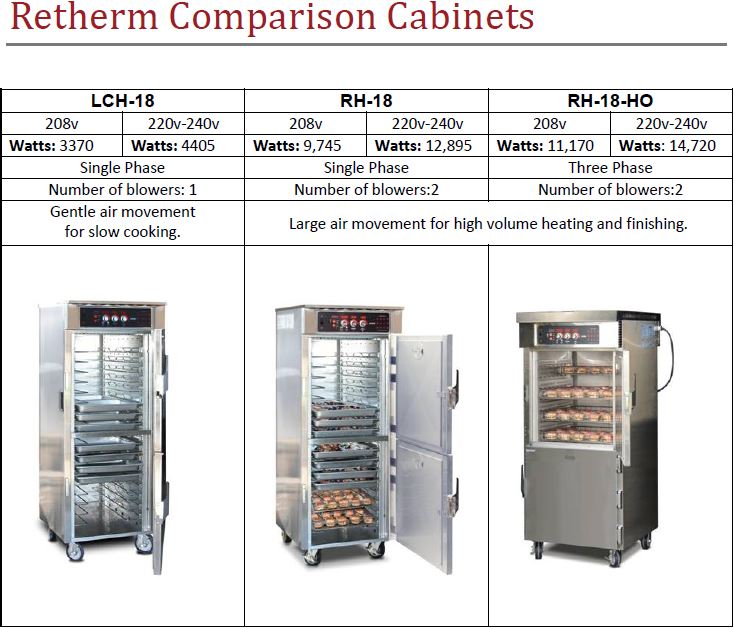
 less are preferred to allow for a safe amount of flexible preparation and cooking time. Retherm ovens are typically found in large institutions such as school, hospitals, and prisons. Retherm ovens allow food preparation to occur off-site, catering to centralized kitchens with satellite operation that have a minimum of other expensive cooking equipment, as well as associated kitchen ventilation systems. Because retherm ovens such as the FWE RH-18, top out at a maximum temperature of 350°F, in most states these ovens are not required to be under expensive ventilation hoods.
In many respects, retherm ovens are similar in design to low temperature convection ovens. A retherm oven however, has about four times the wattage and double the air movement to increase energy transfer efficiency. Retherm efficiency is the transfer of energy from a heated cabinet to a thermal mass (food) in a fast and controlled rate. Testing determines how effective Retherming energy transfers to a thermal mass (food). By testing an empty cabinet and a loaded cabinet, we can compare the energy transfer in kW to the thermal mass (food). Retherm-energy efficiency is a measure of how much of the energy that an appliance consumes is actually delivered to the food product during the rethermalization process.

The larger the thermal mass, the more energy (kW), is needed to transfer to the mass. In the same regards, the more energy (kW) the faster the thermal mass can absorb the energy and reach desired temperatures.
 when a school serves food on a lunch line, bulk food holding cabinets become a necessary piece of equipment to accomplish the job. Holding cabinets such as an FWE UHS-12 are the workhorses of the warming world and can hold bulk food hot and ready to be served for hours. Kitchens can cook large quantities of food well before it needs to be served to their customers, and place it in these FWE warming cabinets where it can stay service ready. This allows the kitchens workload to be spread out during
  preparations for service, freeing up the cooks and chefs time to perform other vital tasks. During service, these food warming cabinets are a place for storage of the food before it reaches the serving areas. Storing food out of the way increases the ease of workflow and helps the service area stay organized and clean.Many quick service restaurants (QSR’s) utilize similar cabinets to hold bulk food before it reaches a prep area or serving line. The cabinets on or near a serving line tend to be shorter in size and may even fit under or be built into a counter. Food in this area is ready for plating, or ready to go on top of the serving line once current food supplies are used up. As for the actual food that can be held? Well, that is as varied as the restaurants themselves. Everything from fresh warm sides such as rice, beans, and proteins that are going to fill a burrito bowl or the tortellini special that is ready for the catering pick up at 12:15pm during the lunch rush.
It’s already a fast pace world, and it’s only going to get faster. Energy drinks and grab and go food items have been flying off the shelves in Convenience Stores these recent years, it’s time you start your Hot Food Program and get some of those profits for yourself. Continue reading “Foodservice – Begining a C-Store Hot Food Program”

 Foodservice.me